My name is Jesper Juul, and I am a Ludologist [researcher of the design, meaning, culture, and politics of games]. This is my blog on game research and other important things.
If you recall the history of game definitions, you remember how Wittgenstein discounted the possibility that the things that we call “games” (or rather Spiele in German) have anything in common, and argued that they rather have family resemblances. Wittgenstein’s argument is basically to say that naive people/philosophers assume that words have definite meanings, but that if we consider his range of examples, from board, to card, to ball games, to Ring a Ring o’ Roses, it will be clear that the things we call games have nothing in common. My response to this has usually been to say that Ring a Ring o’ Roses isnot a game since it does not have quantifiable, variable outcomes to which the game assigns values (also discussed in Half-Real), so that’s that – Ring a Ring o’ Roses is not a problem for the definition of games, since a game definition doesn’t need to include Ring a Ring o’ Roses in the first place.
But lately I have been thinking that Ring a Ring o’ Roses is (or can be) more of a game than I thought. For those of you who haven’t played in a while, here is a video of some children playing it:
And this is what Wittgenstein has to say – I have to quote it all, §66-67 of Philosophical Investigations:
Consider for example the proceedings that we call “games”. I mean board-games, card-games, ball-games, Olympic games, and so on. What is common to them all? — Don’t say: “There must be something common, or they would not be called ‘games’ “-but look and see whether there is anything common to all. — For if you look at them you will not see something that is common to all, but similarities, relationships, and a whole series of them at that. To repeat: don’t think, but look! — Look for example at board-games, with their multifarious relationships.
Now pass to card-games; here you find many correspondences with the first group, but many common features drop out, and others appear.
When we pass next to ball-games, much that is common is retained, but much is lost.– Are they all ‘amusing’? Compare chess with noughts and crosses. Or is there always winning and losing, or competition between players? Think of patience. In ball games there is winning and losing; but when a child throws his ball at the wall and catches it again, this feature has disappeared. Look at the parts played by skill and luck; and at the difference between skill in chess and skill in tennis.
Think now of games like ring-a-ring-a-roses; here is the element of amusement, but how many other characteristic features have disappeared!
I can think of no better expression to characterize these similarities than “family resemblances”; for the various resemblances between members of a family: build, features, colour of eyes, gait, temperament, etc. etc. overlap and cries-cross in the same way.-And I shall say: ‘games’ form a family.
The strange thing always was how easy it is to come up with any number of things that all of Wittgenstein’s examples have in common – they all involve humans participating in a socially defined activity at the very least. That’s the thing with family resemblances – they are within a family, and families usually have shared traits, such as being carbon-based lifeforms and so on. In The Grasshopper Bernard Suits makes the snide remark that Wittgenstein didn’t follow his own advice of looking and seeing – “He looked, to be sure, but because he had decided beforehand that games are indefinable, his look was fleeting, and he saw very little.”
Perhaps that is a little hard on Wittgenstein, but the truth obviously is that he was a theorist of language, not games, and he doesn’t look very hard. This doesn’t detract from his value as a philosopher, I think.
Lately I have played a lot of Ring a Ring o’ Roses (or rather “Ring round the Rosie”) with my toddler son, and I suddenly remembered that Brian Sutton-Smith had once told me that Ring a Ring o’ Roses could be considered a game because it has variable outcome if you are 2-3 years old. At that age, it is really challenging to coordinate all the dancing and falling down as a group. It is a goal that all participants should fall at the same time (the valorization of the outcome), and the group sometimes succeeds and sometimes fails (variable outcome). This is very visible in the video above.
Seen that way, Ring a Ring o’ Roses is akin to tic-tac-toe which is also challenging and interesting up to a certain age, but ceases to work as a game once we understand the strategy. The reason we don’t remember the challenge of Ring a Ring o’ Roses is that we played it mostly before our earliest memories. At the other end of the spectrum, I guess old age will make Ring a Ring o’ Roses into a game for us again.
And just in time for the new year, Game Studies: The International Journal of Computer Game Research has just published its latest issue (Volume 12, Issue 2, December 2012). All articles are available at http://gamestudies.org/1202/
Art requires criticism. Portal transcends videogame tropes: it explores the human struggle against algorithmic processes through complex parallels between the player, Chell, the companion cube, and GLaDOS. Increasingly complex frustrations are experienced directly through the game’s aesthetic of play – a freedom bounded by algorithmic control.
A broad notion of challenge, conceptualized as both demanding and stimulating situations, is here proposed as a basis for holistic analysis of digital games which takes both the games’ mechanic and semiotic dimensions into equal account. The offered framework is demonstrated through application in an analysis of Fallout 3.
This essay is a critical examination of the paradigmatic approach of interpreting computer games as games accessible for analysis and critique through ‘research-play’. The essay justifies a differentiation between game design research and game studies, and explores the avenues of analysis and critique of single-player computer games for the latter.
This paper studies the effect that user created interfaces have had on WoW and its community of users through an online survey issued to WoW players. The survey results illustrate the varied nature of this community and provide information that may aid in the creation of communities dedicated to modifying the interfaces of other software packages.
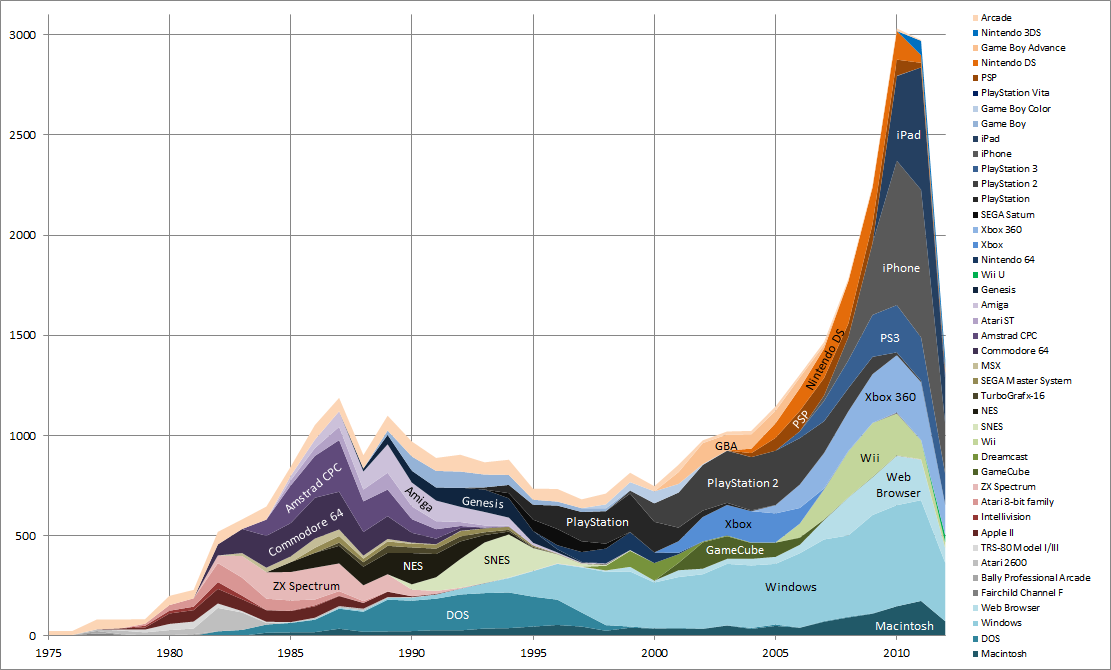
Looking at it, the truth is that the platform part is more useful since the data it concerns is less prone to changing interpretations: a SNES is still a SNES after all these years. But the genre chart really shows how genre labels change over time: “arcade” is no longer a useful category, “action” and “scrolling” even less so.
As a supplementary chart, NcikVGG has posted a platform release history with an absolute vertical axis (counting # of releases). This one shows just how many games are being released these days compared to earlier days. It also shows us how important mobile platforms have become (though Android seems to be missing).
You are hereby invited to the sixteenth installment of the NYU Game Center’s video game theory seminar series.
“The History of Video Games begins in Europe in the 1980’s”. Friday November 16 at 4-6pm.
Location: NYU, 721 Broadway, New York NY 10003, 9th floor conference room. Please RSVP, see below!
If there is one thing that video game historians can agree on, it is the pivotal importance of the 1983 crash of the video game market. Yet, the crash went largely unnoticed in Europe where consoles were few and the industry only nascent. The history of European video games in 1980’s is better described as a period of unbroken growth and unprecedented experimentation in game design. In this session, our two speakers will discuss the history of early European experimental and independent games, and show how they prefigured much of what is happening in the video games today.
The two speakers of the day are Jaroslav Švelch from Charles University (Prague) and Jesper Juul from the NYU Game Center.
The Talks
Švelch: The Unintended Avant-garde – Two stories from 1980’s European game development
The talk discusses two separate stories from the history of computer games, united by the fact that the games at the center of these stories broke new grounds without much impact or commercial success. First, we will discuss the British game “Deus Ex Machina”, probably the first commercially released art game, designed in 1984 by Mel Croucher, whose mission to express abstract human experiences in many ways resembles today’s indie and art games. Secondly, we will talk about the text adventure game “The Adventures of Indiana Jones on Wenceslas Square in Prague on January 16, 1989”, which preceded editorial game design of games like Raid Gaza in being a response to contemporary events – in this case, the violently suppressed anti-regime demonstration in Czechoslovakia.
Juul: Indie Games are from Europe
In this talk, I will return to some of the most influential European games of the mid-1980’s and show how they contain both forgotten possibilities that we have yet to bring to fruition, as well as the seeds of many of the current themes in video games, such as the independent developer, games as experiment and personal expression, and the kind of short-turnaround cloning that we find in mobile distribution channels. At the same time, the discussion of video games in the especially the UK gaming press at the time was decidedly un-romantic, avoiding any discussion of games as an art form, vehicle of expression, or indeed as anything more than utility.
Speaker bios
Jaroslav Švelch is a Ph.D. candidate, lecturer and researcher at Charles University, and currently also a research intern at Microsoft Research New England. He holds a Bachelor’s degree in Journalism and Master’s degrees in Media Studies, and Linguistics and Phonetics/Translation Studies, all from Charles University in Prague. His research focuses on social uses of entertainment technology, history of computer games, language management online and the concepts of monstrosity and adversity in virtual spaces.
Jesper Juul has been working with the development of video game theory since the late 1990’s. He is a visiting arts professor at the NYU Game Center, and has previously worked at the Singapore-MIT GAMBIT Lab at MIT, the Danish Design School, and at the IT University of Copenhagen. His book Half-Real on video game theory was published by MIT press in 2005. His book A Casual Revolution examines how puzzle games, music games, and the Nintendo Wii brought video games to a new audience. His upcoming book The Art of Failure will be published in spring 2013. He maintains the blog The Ludologist on “game research and other important things”. Jesper Juul co-edits the Playful Thinking book series for MIT Press.
The theory seminars are aimed at researchers, industry professionals and students. Please RSVP so you can get into the building! jesper.juul (at) nyu.edu
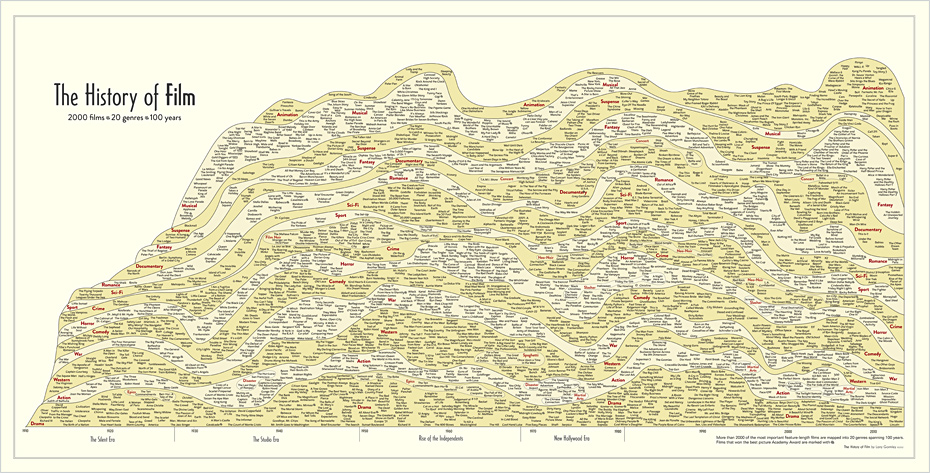
Ever since I wrote the Swap Adjacent article on matching tile games, I have been fascinated with the challenge of writing, and visualizing the history of art forms.
Here is Larry Gomley’s History of Film poster (clearly inspired by Reebee Garofalo’s genealogy of Pop/Rock music), in which we can see the major genres developing over time.
Before we pile on the criticism (US-centric etc..), there are three major reasons for attempting things like this:
It is an interesting way of condensing a large amount of information into a snapshot.
The process of reducing thousands of works into an overview is in itself interesting: how are we thinking about these things, and how would we express them visually?
Some of us ( me for example) were told in no uncertain terms during our university education that you just can’t write histories like this. So let’s do it!
Designing for the Pleasures of Disputation -or- How to make friends by trying to kick them!
In this dissertation I explore what it might mean to design games that aim to nurture a spirit oftogetherness. My central claim is that games which are intentionally designed to be confrontational, broken, or otherwise “incomplete” can help inspire a decidedly festive, co-dependent, and performative type of play. Appropriating the political theoretical work of Hannah Arendt, I argue that her concepts of “action” and “plurality” provide useful definitions of performance and togetherness as they relate to gameplay. Drawing primarily on theories of embodied interaction, precedents from the contemporary art world, and various folk game movements, I grapple with the messy relationship between designed systems and sociocultural context. I describe how confronting this relationship head-on opens up fruitful design opportunities. Taking seriously Dave Hickey’s concept of “the pleasures of disputation,” I explore how we players and designers might transmute the acrimony of conflict into something joyful.