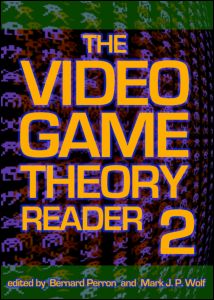
The Video Game Theory Reader 2 is here, edited by Bernard Perron and Mark Wolf.
My own piece is Fear of Failing? The Many Meanings of Difficulty in Video Games. You can read my piece here, but get the book (Amazon US, Amazon UK), of course – lots of interesting articles.
- Foreword – Tim Skelly
- Introduction – Bernard Perron and Mark J. P. Wolf
- Gaming Literacy: Game Design as a Model for Literacy in the 21st Century – Eric Zimmerman
- Philosophical Game Design – Lars Konzack
- The Video Game Aesthetic: Play as Form – David Myers
- Embodiment and Interface – Andreas Gregersen and Torben Grodal
- Understanding Video Games as Emotional Experiences – Aki Jarvinen
- In the Frame of the Magic Cycle: The Circle(s) of Gameplay – Dominic Arsenault and Bernard Perron
- Understanding Digital Playability – Sebastien Genvo
- Z-axis Development in the Video Game – Mark J. P. Wolf
- Retro Reflexivity: La-Mulana, an 8-Bit Period Piece – Brett Camper
- “This is Intelligent Television”: Early Video Games & Television in the Emergence of the Personal Computer – Sheila C. Murphy
- Too Many Cooks: Media Convergence and Self-Defeating Adaptations – Trevor Elkington
- Fear of Failing? The Many Meanings of Difficulty in Video Games – Jesper Juul
- Between Theory and Practice: The GAMBIT Experience – Clara Fernandez-Vara, Neal Grigsby, Eitan Glinert, Philip Tan, and Henry Jenkins
- Synthetic Worlds as Experimental Instruments – Edward Castronova, Mark W. Bell, Robert Cornell, James J. Cummings, Matthew Falk, Travis Ross, Sarah B. Robbins and Alida Field
- Lag, Language, & Lingo: Theorizing Noise in Online Game Spaces – Mia Consalvo
- Getting into the Game: Doing Multi-Disciplinary Game Studies – Frans Mayra