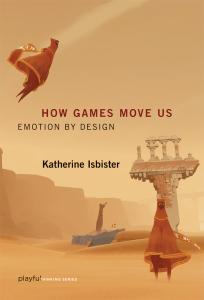
 I am interviewing Katherine Isbister on the MIT Press website about her new book How Games Move Us (in the Playful Thinking series).
My name is Jesper Juul, and I am a Ludologist [researcher of the design, meaning, culture, and politics of games]. This is my blog on game research and other important things.

I am interviewing Katherine Isbister on the MIT Press website about her new book How Games Move Us (in the Playful Thinking series).
For your very real, theoretical pleasure:
| Editorial — Game Studies In Media Res: Beginning From The Middle-State | |
| Michael Hancock, Steve Wilcox | |
| Editorial introduction to this special guest-edited issue of Loading. |
| The Tyranny of Realism: Historical accuracy and politics of representation in Assassin’s Creed III | |
| Adrienne Shaw | |
| Like other games in its series, Assassin’s Creed III (AC3) is heavily invested in a wellresearched, nuanced representation of historical… |
| Disability, Neurological Diversity, and Inclusive Play: An Examination of the Social and Political Aspects of the Relationship between Disability and Games | |
| Sarah Gibbons | |
| This article explores existing connections between disability studies and game studies, and suggests how the two fields might greater inform each… |
| Renegade Sex: Compulsory Sexuality and Charmed Magic Circles in the Mass Effect series | |
| Meghan Blythe Adams | |
| This article examines portrayals of sexuality in video games, particularly in terms of the increasing inclusion of queer and non-normative… |
| Cyborg Games: Videogame Blasphemy and Disorientation | |
| Elise Vist | |
| This paper describes the genre of “cyborg games,” using examples of independent videogames (such as Gone Home) to illustrate the genre, as well… |
| Going Beyond the Game: Development of Gamer Identities Within Societal Discourse and Virtual Spaces | |
| Jan Grooten, Rachel Kowert | |
| What is a ‘gamer’? And what does it mean to be a gamer today? This paper will address these questions through a theoretical discussion of the… |
| The Game FAVR: A Framework for the Analysis of Visual Representation in Video Games | |
| Dominic Arsenault, Pierre-Marc Côté, Audrey Larochelle | |
| This paper lays out a unified framework of the ergodic animage, the rule-based and interactiondriven part of visual representation in video games…. |
For your analog interests, here is Volume II, Issue VII of Analog Game studies.
Manipulating Environments in American Freeform – Jason Cox
Playing With Portals: Rethinking Urban Play With Ingress – Kyle Moore
The Eurogame of Heterotopia – Devin Wilson
The First Nations of Catan: Practices in Critical Modification – Greg Loring-Albright
In this final issue of the year, we are exploring material components of analog gameplay. The materiality of games is important to consider as it lends insight into the ways that games can be located within the clear parameters of space and time—often despite the best efforts of players and designers to otherwise construe them as timeless or nostalgic media. Additionally, materialities help to remind us of the limitations of play. Our bodies must navigate black-box theater rooms and city spaces, as manipulate pawns, chits, meeples, cards and other trappings of board games. These deliberate, sometimes awkward, yet often tacit negotiations help to remind us of the always-present stakes of materiality.
Jason Cox’s essay “Manipulating Environments in American Freeform” offers a starting point for those curious about the ways in which emerging practices of larp design offer more to players than just narrative—they tell stories about spaces as well, and attend to how environments affect our bodies. This is also what is at stake in Kyle Moore’s essay, “Playing With Portals: Rethinking Urban Play with Ingress,” a theoretical sketch of the ways that the game, formerly a Google product, compels players to experience urban space in new and often challenging ways. Finally, the last two essays in this issue, Devin Wilson’s “The Eurogame as Heterotopia,” and Greg Loring-Albright’s “The First Nations of Catan: Practices in Critical Modification”—both in dialogue with last year’s AGS essay by Will Robinson—take up critiques of the abstracted representations characteristic of Eurogames. Wilson’s piece argues for a new and less oppositional reading of abstract game materials, positioning them as a space of polysemic and potentially revolutionary interpretation. In contrast, Loring-Albright moves forward from the problematic of abstraction established by Robinson by offering a new critical ruleset for Catan that accounts for the erasure of indigenous peoples in the game’s narrative. And, in the spirit of materiality: we’ve included the rules as a bonus to our readers.
Thank you, readers, for an excellent year, and keep an eye out in the coming months for more exciting content!
-The Editors
November 9, 2015
For your theory itch: Journal of Virtual Worlds Research issue 8, 2.
From the point of view of 2015: the virtual is becoming the real and the real is becoming the virtual.
| Toward the Futures of Real AND Virtual Worlds | |
| Yesha Y. Sivan |
| Three Real Futures for Virtual Worlds | |
| Tom Boellstorff |
| Is a Technological Singularity Near Also for Bots in MMOGs? | |
| Stefano De Paoli |
| Conceptualizing Factors of Adoption for Head Mounted Displays: Toward an Integrated Multi-Perspective Framework | |
| Ibrahim Halil Yucel, Robert Anthony Edgell |
| Being There: Implications of Neuroscience and Meditation for Self-Presence in Virtual Worlds | |
| Carrie Heeter, Marcel Allbritton |
| The eSports Trojan Horse: Twitch and Streaming Futures | |
| Benjamin Burroughs, Paul Rama |
| The Metaverse as Mediator between Technology, Trends, and the Digital Transformation of Society and Business | |
| Sven-Volker Rehm, Lakshmi Goel, Mattia Crespi |

Set for launch in February 2016, we are proud to present the fifth book of the Playful Thinking Series. Katherine Isbister’s How games Move Us: Emotion by Design is an examination of how video game design can create strong, positive emotional experiences for players, with examples from popular, indie, and art games.
This is a renaissance moment for video games—in the variety of genres they represent, and the range of emotional territory they cover. But how do games create emotion? In How Games Move Us, Katherine Isbister takes the reader on a timely and novel exploration of the design techniques that evoke strong emotions for players. She counters arguments that games are creating a generation of isolated, emotionally numb, antisocial loners. Games, Isbister shows us, can actually play a powerful role in creating empathy and other strong, positive emotional experiences; they reveal these qualities over time, through the act of playing. She offers a nuanced, systematic examination of exactly how games can influence emotion and social connection, with examples—drawn from popular, indie, and art games—that unpack the gamer’s experience.
Isbister describes choice and flow, two qualities that distinguish games from other media, and explains how game developers build upon these qualities using avatars, non-player characters, and character customization, in both solo and social play. She shows how designers use physical movement to enhance players’ emotional experience, and examines long-distance networked play. She illustrates the use of these design methods with examples that range from Sony’s Little Big Planet to the much-praised indie game Journey to art games like Brenda Romero’s Train.
Isbister’s analysis shows us a new way to think about games, helping us appreciate them as an innovative and powerful medium for doing what film, literature, and other creative media do: helping us to understand ourselves and what it means to be human.

Well Played: volume 4 number 2
Stephen Jacobs and Ira Fay et al. 2015
Medulla: A 2D sidescrolling platformer game that teaches basic brain structure and function
Joseph Fanfarelli, Stephanie Vie
Play or science? a study of learning and framing in crowdscience
Andreas Lieberoth, Mads Kock Pedersen, Jacob Friis Sherson
Barriers To Learning About Mental Illness Through Empathy Games – Results Of A User
Study On Perfection
Barbara Harris, Mona Shattell, Doris C. Rusch, Mary J. Zefeldt
Zombie-based critical learning – teaching moral philosophy with The Walking Dead
Tobias Staaby
Distributed Teaching and Learning Systems in Dota 2
Jeffrey B. Holmes
An Analysis of Plague, Inc.: Evolved for Learning
Lorraine A. Jacques
Another day, another report about how common video gaming is.
The Digital Australia 2016 report says that 68% of the Australian population plays video games.
Summary here.
The Journal of Comparative Research in Anthropology and Sociology has a new special issue on Video games and insightful gameplay, guest edited by Doris Rusch.
Journal of Comparative Research in Anthropology and Sociology
ISSN 2068 – 0317
Special issue: Video games and insightful gameplay
Volume 6, Number 1
Guest Editor: Doris C. Rusch
***
Editorial
Doris C. Rusch / Video games and insightful gameplay
[Full text / pdf]
Research articles – Special issue on Video Games and Insightful Gameplay
Matt Bouchard / Playing with progression, immersion, and sociality: Developing a framework for studying meaning in APPMMAGs, a case study
[Abstract] [Full text / pdf]
Ioana Cărtărescu-Petrică / Those who play together stay together. A study of the World of Warcraft community of play and practice
[Abstract] [Full text / pdf]
Joanna Cuttell / Arguing for an immersive method: Reflexive meaning-making, the visible researcher, and moral responses to gameplay
[Abstract] [Full text / pdf]
Daniel de Vasconcelos Guimarães / Apocalyptic souls: the existential (anti) hero metaphor in the Metal Gear Solid: Snake Eater, Peace Walker and Ground Zeroes games
[Abstract] [Full text / pdf]
Mikhail Fiadotau / Paratext and meaning-making in indie games
[Abstract] [Full text / pdf]
Sonja Gabriel / Serious games – How do they try to make players think about immigration issues? An overview
[Abstract] [Full text / pdf]
Enrico Gandolfi / Once upon a bit: Ludic identities in Italy, from militant nostalgia to frivolous divertissement
[Abstract] [Full text / pdf]
Kishonna Gray & Wanju Huang / More than addiction: Examining the role of anonymity, endless narrative, and socialization in prolonged gaming and instant messaging practices
[Abstract] [Full text / pdf]
Scott Hughes / Get real: Narrative and gameplay in The Last of us
[Abstract] [Full text / pdf]
Youn Jung Huh / Making sense of gender from digital game play in three-year-old children’s everyday lives: An ethnographic case study
[Abstract] [Full text / pdf]
Xeniya Kondrat / Gender and video games: How is female gender generally represented in various genres of video games?
[Abstract] [Full text / pdf]
Alina Petra Marinescu-Nenciu / Collaborative learning through art games. Reflecting on corporate life with ‘Every Day the Same Dream’
[Abstract] [Full text / pdf]
Elisabeta Toma / Self-reflection and morality in critical games. Who is to be blamed for war?
[Abstract] [Full text / pdf]
Max Watson / A medley of meanings: Insights from an instance of gameplay in League of Legends
[Abstract] [Full text / pdf]
Other research articles
Yitzhak Alfasi, Moshe Levy & Yair Galily / Israeli football as an arena for post-colonial struggle: The case of Beitar Jerusalem FC
[Abstract] [Full text / pdf]
Gautam Ghosh / An ‘infiltration’ of time? Hindu Chauvinism and Bangladeshi migration in/to Kolkata, India
[Abstract] [Full text / pdf]
Adediran Daniel Ikuomola / An exploration of life experiences of left behind wives in Edo State, Nigeria
[Abstract] [Full text / pdf]
Andra Jacob / Migrant’s houses as places and objects of cultural consumption and status display
[Abstract] [Full text / pdf]
Book reviews
Alin Constantin /Book review – Roland Cvetkovski & Alexis Hofmeister, An Empire of Others: Creating Ethnographic Knowledge in Imperial Russia and the USSR, Central European University Press, Budapest, 2014.
[Full text / pdf]