
Is out now, and can be downloaded free of charge from the ETC web site.
Category: readings
Game Studies 13/2 on Game History
For your theoretical pleasure, here is the Game Studies 13/2 special issue on Game History.
*
The Platform and the Player: exploring the (hi)stories of Elite
by Alison Gazzard
This article explores the landscape of British computer games through a case study of Elite. Utilising archival methodologies inherent in media archaeology, combined with approaches from platform studies, a history of Elite is approached through both its original development and the players’ responses to the game at the time. [more]
*
A Pedestal, A Table, A Love Letter: Archaeologies of Gender in Videogame History
by Laine Nooney
This article is a methodological exploration of gender as it relates to the writing of game history. This contribution presents three case studies, focused on the biography of Sierra On-Line cofounder and lead designer Roberta Williams, to analyze this historical mechanisms through which women are located — and left out of — game history. [more]
*
by David Parisi
This archaeological analysis of gamic electroshock charts changes in the way that electricity has been employed as a game mechanic, opening with an examination of the 18th century ‘electric kiss’ game, moving to a treatment of early 20th century arcade electricity, and concluding with a discussion of ludic electric shock in recent game art. [more]
*
The Foundation of Geemu: A Brief History of Early Japanese video games
by Martin Picard
The paper presents a short history of the beginning of the Japanese video game industry (from 1973 to 1983). It argues that specific local developments of a video game industry and market took place in Japan, which has never been addressed in Western histories of games, mainly interested in Japanese video games through a global perspective. [more]
*
Say it with a Computer Game: Hobby Computer Culture and the Non-entertainment Uses of Homebrew Games in the 1980s Czechoslovakia
by Jaroslav Švelch
Based on historical research into computer games in the 1980s Czechoslovakia, this article traces the uses of the medium in the context of an amateur community. It argues that the entertainment function of local homebrew games was often overshadowed by their potential as a means of communication among the community of users. [more]
Game Studies 13/1 is out
For your theoretical pleasure, Game Studies: The International Journal of Computer Game Research has just published its latest issue (Volume 13, Issue 1, September 2013). All articles are available at http://gamestudies.org/1301/
Contents
A Kinesthetic Theory of Videogames: Time-Critical Challenge and Aporetic Rhematic
by Veli-Matti Karhulahti
http://gamestudies.org/1301/ar
This article looks into the mostly unexplored difference between kinesthetic and nonkinesthetic videogame challenge. The difference is refined into a challenge-based theory for understanding the videogame and its peculiar rhetorical character.
Sonic Mechanics: Audio as Gameplay
by Aaron Oldenburg
http://gamestudies.org/1301/ar
The work discusses the past and potential future intersections between game design and theories within contemporary sound art. The author will describe his design process in the creation of several experimental audio games. These range from music composition based on chance game events to silent games that simulate aspects of sound.
Automatic-Play and Player Deskilling in MMORPGs
by Stefano De Paoli
The concept of automatic-play refers to the use of game bots, macros and other software that allow a total or partial automation of gameplay and in particular avatar levelling. The paper theorizes a key aspect of the automation of gameplay: the deskilling of players with the transfer of human skills to automatic-play software.
A Review of Ludoliteracy: Defining, Understanding and Supporting Games Education
by Siobhán Thomas
http://gamestudies.org/1301/ar
Ludoliteracy: Defining, understanding, and supporting games education (2010). by José P. Zagal. Pittsburgh, PA: The ETC Press. ISBN:978-0-557-27791-9.
Game Developer Magazine, complete archive 1994-2013
I felt it a bit sad when Game Developer Magazine closed down in July. Though it was for a long clear that specialist magazines were threatened by, well, the internet, GDMag did provide an edited sense of what was happening in the game industry at any given time (with a North American slant, of course). I also remember poring over introductions to network programming in (it must have been) 1995 or so.
Now the entire back archive of the magazine is available directly for free, in PDF form. http://www.gdcvault.com/gdmag
It is pretty good as a document of 20 years of video game history. Remember when we were all (and all students were) aspiring to be AAA developers? It really happened, and here is the documentation.
Well Played: volume 2 number 2 – Theories
And here is volume 2, number 2 of the Well Played Journal titled Theories, John Sharp et al. 2013.
Inhabiting Games Well (If not Uncomfortably…) – Casey O’Donnell
Critical Literacy: Game Criticism for Game Developers – Yotam Haimberg
Well-played and well-debated: Understanding perspective in contested affinity spaces – Sean Duncan
On justification: WoW, EQ2 and Aion forums – Thibault Philippette, Baptiste Campion
Why we Glitch: process, meaning and pleasure in the discovery, documentation, sharing and use of videogame exploits – Alan Meades
Greg Costikyan’s new book, Uncertainty in Games
Bringing your attention to Greg Costikyan’s new book Uncertainty in Games. This is the second volume in the Playful Thinking Series that I co-edit with Geoffrey Long and William Uricchio.
Get it from MIT Press, Amazon US, UK. (Sorry about all the stores I am not linking to.)
Description
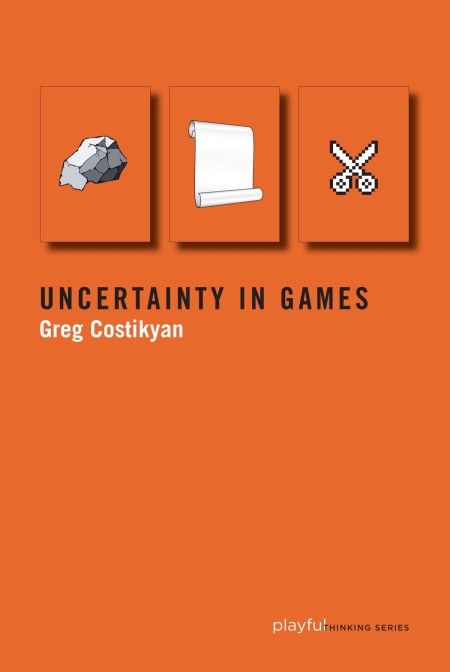 In life, uncertainty surrounds us. Things that we thought were good for us turn out to be bad for us (and vice versa); people we thought we knew well behave in mysterious ways; the stock market takes a nosedive. Thanks to an inexplicable optimism, most of the time we are fairly cheerful about it all. But we do devote much effort to managing and ameliorating uncertainty. Is it any wonder, then, asks Greg Costikyan, that we have taken this aspect of our lives and transformed it culturally, making a series of elaborate constructs that subject us to uncertainty but in a fictive and nonthreatening way? That is: we create games.
In this concise and entertaining book, Costikyan, an award-winning game designer, argues that games require uncertainty to hold our interest, and that the struggle to master uncertainty is central to their appeal. Game designers, he suggests, can harness the idea of uncertainty to guide their work.
Costikyan explores the many sources of uncertainty in many sorts of games—from Super Mario Bros. toRock/Paper/Scissors, from Monopoly to CityVille, from FPS Deathmatch play to Chess. He describes types of uncertainty, including performative uncertainty, analytic complexity, and narrative anticipation. And he suggest ways that game designers who want to craft novel game experiences can use an understanding of game uncertainty in its many forms to improve their designs.
Transactions of the Digital Games Research Association 1, 1
Just out, the inaugural issue of Transactions of the Digital Games Research Association (ToDiGRA).
ToDiGRA is meant as a venue for publishing some of the best papers from DiGRA conferences.
Vol 1, No 1 (2013)
A selection of best papers from the DiGRA 2011 conference in Hilversum, the Netherlands.
Table of Contents
Annika Waern, José Zagal: Introduction – HTML PDF
Jason Begy: Experiential Metaphors in Abstract Games – HTML PDF
René Glas: Breaking Reality: Exploring Pervasive Cheating in Foursquare – HTML PDF
Ioanna Iacovides, James Aczel, Eileen Scanlon, Will Woods: Making sense of game-play: How can we examine learning and involvement? –HTML PDF
Jonas Linderoth: Beyond the digital divide: An ecological approach to gameplay – HTML PDF
Gareth Schott, Jasper van Vught: Replacing preconceived accounts of digital games with experience of play: When parents went native in GTA IV – HTML PDF
New issue of G|A|M|E, the Italian Journal of Game Studies
New issue of G|A|M|E, the Italian Journal of Game Studies.
vol. 1, 2013 – Journal: TECHNOLOGY EVOLUTION AND PERSPECTIVE INNOVATION
- Editorial Board – Technology evolution and perspective innovation. 3D and spatial depth today and yesterday
- D. Pietschmann, B. Liebold, G. Valtin & P. Ohler – Taking space literally: reconceptualizing the effects of stereoscopic representation on user experience
- A. Petrovits, A. Canossa – From M.C. Escher to Mass Effect: impossible spaces and hyper-real worlds in video games. How can hyper-real worlds be designed and interpreted in a 2D, 2.5D and 3D virtual environment and how will this implementation affect the stereoscopic 3D video games of the future?
- A. Larochelle – A new angle on parallel languages: the contribution of visual arts to a vocabulary of graphical projection in video games
- A. Işığan – The production of subject and space in video games
- D. Arsenault & P.-M. Côté – Reverse-engineering graphical innovation: an introduction to graphical regimes
- Z. Street – Polygons and practice in Skies of Arcadia
- D. Arsenault, P.-M. Côté, A. Larochelle & S. Lebel – Graphical technologies, innovation and aesthetics in the video game industry: a case study of the shift from 2D to 3D graphics in the 1990s
- E. Menduni & A. Catolfi – Digital aesthetic forms between cinema and TV. The need for new research directions
Get it here: http://www.gamejournal.it/issues/game-n-22013/