Archive for the 'meta' Category

Co potrafią,a czego nie potrafią gry komputerowe (What computer games can and can’t do)

Friday, June 13th, 2008

Peter Wojcieszuk has graciously translated my paper What computer games can and can’t do into Polish: Co potrafią,a czego nie potrafią gry komputerowe.

This paper (from 2000) was the first time I made a position statement about the need for video game theory, for a ludology.

Many of the things the paper asks for seem to have come true, but we are not exactly done (and it probably not technically possible to be done, we can just get further).

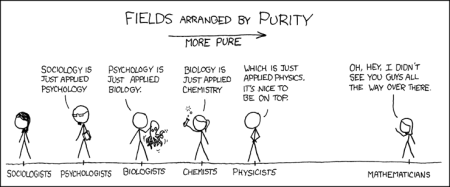
Which field is on top?

Wednesday, June 11th, 2008

XKCD sorts fields by perceived purity today:

I think many more fields believe themselves to be on top than what is implied here. But that’s the fun of it, isn’t it?

As a philosophy discussion grows longer, the probability of someone asking, “but what is reality?” approaches one

Friday, May 9th, 2008

The philosopher’s version of Godwin’s law:

As a philosophy discussion grows longer, the probability of someone asking, “but what is reality?” approaches one.

Keynoting at the Game Philosophy Conference in Potsdam

Monday, May 5th, 2008

This week I am keynoting at the Philosophy of Computer Games conference in Potsdam, May 8-10.

My talk is Who Made the Magic Circle? Seeking the Solvable Part of the Game-Player Problem.

If the early days of game studies concerned the issue of games and stories, recent discussions appear to be focused on the issue of games and players. This is a discussion of methods and of the object of study: Should we discuss players or should we discuss games? There are two possible perspectives on this: The common “segregationist” perspective implies that games are structures separate from players, structures that players can subsequently subvert. In this talk, I will make the case for an alternative “integrationist” perspective wherein games are chosen and upheld by players, and where players will happily create formal rule systems and boundaries around the playing activity.
I will argue that the question of games and players must therefore be decomposed into a set of smaller problems, each of which must be answered with different methods.

It’s a meta-talk! Looking forwards to the conference.

What have you changed your mind about?

Wednesday, January 2nd, 2008

Edge.org presents their yearly question to various thinkers and scientists. This time it is:

WHAT HAVE YOU CHANGED YOUR MIND ABOUT? WHY?

Lots of good stuff.

Me, I changed my mind about fiction in games – I used to discount it, but then realized my error.
[Clarification: This change of mind happened between 1998 and 2003. Half-Real was written after I changed my mind.]

I find it pretty fascinating to change my mind – suddenly you are in a slightly different world from before and everything has to be reevaluated.

On the other hand, I did change my mind about changing my mind as being always-good. It can also be overdone with a certain self-indulgent gesture as in “5 minutes ago I thought X, but now I realize it’s Y, and I am never afraid to admit mistakes – that’s how great I am!”

And you don’t want to go there either. This is one of the things that makes life (and research) so amazingly interesting.

Happy 2008!

Zotero, Zotero – a Genuinely Useful Research Tool

Friday, December 14th, 2007

I stumbled upon the reference management software Zotero, and it is fabulous so far. I feel like blogging about it.

It’s a Firefox plugin that allows you to capture not only bibliographical information from Amazon, but also web pages, blog posts, etc… and store them in a subject hierarchy. And export them for bibliographes later. And take snapshots of web pages. And add notes.

Here’s why it works well:

  • Entries can be several places in  the subject hierarchy. Let’s face it, the hierarchical bookmark structure of current browsers is completely broken since 1/3 of all entries belong several places in the hierarchy (i.e. video game theory/players and video game design / playtesting). (I actually wrote my own program for this a few years ago, but it was nowhere near the usefulness of Zotero.)
  • It is integrated into your browser where you do your work anyway.
  • It takes snapshots of web pages, so you can reference them even when they’re gone.
  • Notes, web pages, books, etc. are treated on the same level.
  • It understands that research work is managing and navigating resources. (As opposed to something like EndNote that seems to assume that the core of research is writing bibliographies in MLA or Chicago style.)

What is missing?

  • So far, the main lack is that video games are not included as a reference type. (It could even have integration with MobyGames.)
  • Mass import of existing Firefox bookmarks.

Zotero

Workshop: For a Theory of the Novel of the 21st Century

Sunday, April 15th, 2007

Center for the Study of the Novel, Stanford, April 20-21:

Workshop: For a Theory of the Novel of the 21st Century

Here, I will be participating in a two-day workshop of a more literary nature:

Please join us for our last event of the CSN 2006-2007 season. This two-day workshop gathers together a younger generation of novel scholars now emerging to national and international prominence to discuss future directions in the field.

More here.

What do Games Mean? Braid, then flOw pulled from Slamdance

Tuesday, January 9th, 2007

More fallout from Peter Baxter’s decision to remove Super Columbine Massacre from the Slamdance festival:

First Jonathan Blow pulled Braid, and now Jenova Chen has pulled flOw.

Not much to say, the error of Baxter’s decision so obvious, and Blow and Chen deserving credit for sticking out their neck.

The basic problem is this: For unknown reasons, some people assume that games always condone the actions of the player or the events in the game. This is obviously wrong, so let me offer a broader perspective with what I wrote in Half-Real about what games mean:

*

Where is the moral?

As a first example, consider Cecil B. DeMille’s film The Ten Commandments (1956). With Charlton Heston playing the part as Moses, we follow the biblical tale about the birth of Moses, his adoption, the exodus from Egypt, Moses parting the waters, and finally receiving the Ten Commandments from God. In this film, it is clear that the protagonist is good, and that his actions are good. This means that we see the protagonist as carrier of the film’s moral, but are protagonists always good? We can compare the Ten Commandments to Mozart’s opera Don Giovanni: The personal goal of Don Giovanni is to seduce as many women as possible, something at which he is sublimely skilled. Towards the end of the opera, Don Giovanni is offered the option of repenting his sins, but he refuses and is finally swallowed by the flames of hell. It should be clear that the moral of the opera is that God punishes sinners, and that the protagonist demonstrates what we should not do. We do not automatically assume that the actions of a protagonist are “good” or “right”.

[...]

A meaningful car crash

We can see why it would be a misunderstanding to see a game as an expression of the players wanting to perform the in-game actions in reality. Games are rather – like stories – things that we use to relate to death and disaster. Not because we want them to happen, but because we know they exist. Consider the game Burnout 2 (Criterion Studios 2002). Burnout 2 can be played in a special crash mode, where the object is to drive into a busy intersection at full speed in order to create as large pile-ups as possible (fig. 5.18). It should be obvious that we do not play this game because we want traffic accidents, but because we know they exist and because we want to consider the possibility of death and destruction.

Burnout intersection Burnout buses

Figure 5.18. Burnout 2 (Criterion Studios 2002), crash mode: Create the largest traffic accident possible.

The audience of a movie does not automatically assume that the protagonist does good, and neither does the player of a video game believe that the protagonist of the game does good. A game is rather play with identities, where the player at one moment performs an action considered morally defensible, and the next moment tries something that the player considers indefensible. The player chooses one mission or another, tries to complete the mission in one way or another, tries to do “good” or “evil”. Games are playgrounds where players can experiment with doing things they would or would not normally do.

[...]

I think that having the tools for discussing games, and remembering how we interpret other cultural forms can prevent us from making na?ve, literal interpretations of games.

(Half-Real, p. 191-194).